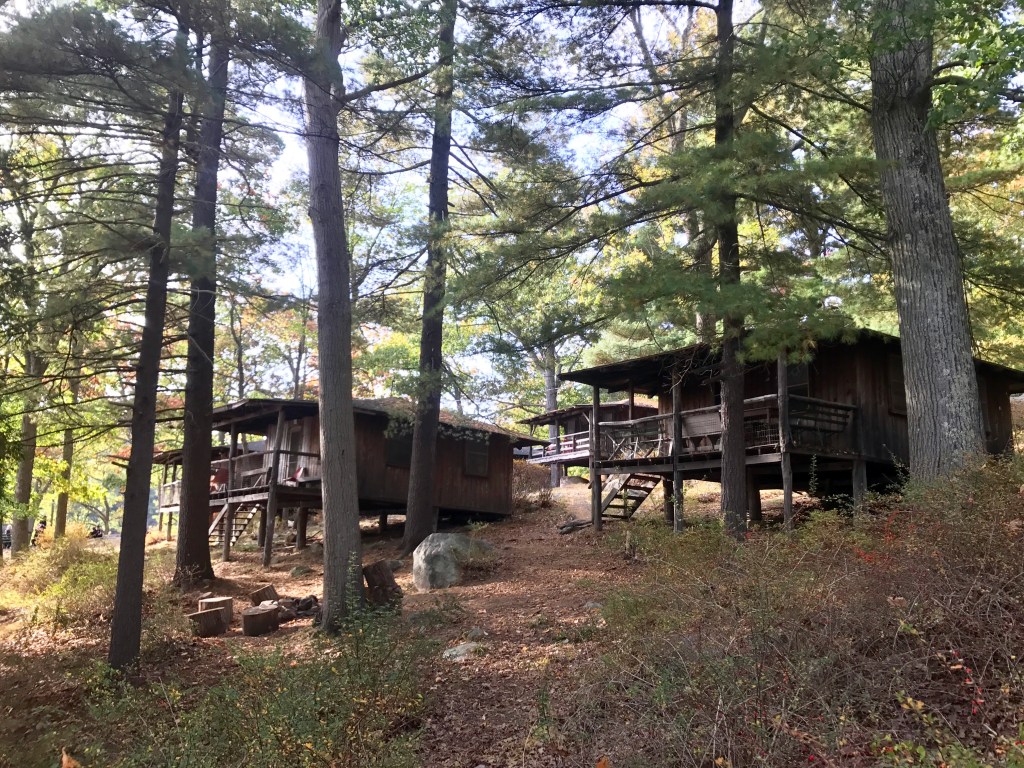
When the crickets in the trees sound like fire alarms in need of new batteries, I know it’s coming. The last of the heat and humidity, a couple more weeks ‘til the color parade, then the dreaded end of daylight saving time. Time to take to the woods to torture the children with a cabin trip. In my experience, kids’ memories of vacation spots are inversely proportionate to how grubby the place is. I mean we’ve stayed in some pretty darn nice hotels all over the world, but it’s The Snowy Owl Lodge they recall, and the loveliest thing about it was its name.
I have sorted through many dumps to find a good one. Like that needle in the haystack, they are hard to find. But I’ve hit the jackpot with Harriman State Park. The kids will never forget our night at Baker Camp there last fall, complete with devil worshippers, acorns pounding our tin roof all night and an injury requiring medical attention. Unfortunately Baker Camp has since been torn down, but not to worry. I’ve unearthed a few more jewels.
Harriman State Park is actually the Mother of all Cabin Camping, created specifically for it. It’s only 30 miles from Rye, bordered on the east by the Palisades Interstate Parkway, the west by I-87, south by I-287 and north by West Point. It’s a glorious 47,527 acres stuffed into a rectangle 15 miles tall and 5 miles wide, chockful of mountains, lakes, ponds, streams, trails and woods.
Its history is fascinating, beginning with the formation of the Palisades Interstate Park Commission (PIPC) in the late 1800s to preserve the scenery on either side of the Hudson. Led by George W. Perkins, the PIPC stopped the destruction of the Palisades. Plans to move Sing Sing Prison from Ossining to Bear Mountain prompted railroad magnate Edward H. Harriman to buy and donate thousands of acres to the PIPC if it would match his gift. Harriman’s vision was to preserve a vast swath of land for the public of future generations by donating his private holdings. It came to pass (as did he) when his wife Mary and son William held true to his plan.
Bear Mountain and Harriman State Parks are adjacent properties with separate boundaries, Harriman being nine times larger. Bear Mountain became the more heavily trafficked, popular with day visitors. But Harriman was ideal for those seeking more of a wilderness experience. It was the empty slate for the genius of Major William Welch, chief landscape engineer of the PIPC from 1912-1940. Welch envisioned and created a “wild” park to last for all time. He master planned and oversaw construction of fifteen lakes, dams, over 100 camps, hundreds of trails (including the first segment of the Appalachian Trail), water and sewage systems and the fabulous Seven Lakes Drive which opened in 1915 to connect the parks. Trail shelters, fire towers, a ski slope, a roller rink and interior roads were gradually added. During the Depression, the Civilian Conservation Corps built many of these projects.
Unfortunately the cost of remaining true to the park’s mission, to provide a wilderness experience for those seeking an escape from urban areas, was high. The PIPC purchased more and more land from farmers living in and near the parkland. They sold willingly at first, but later the PIPC relied on eminent domain to force landowners out. Homesteads were turned into mess halls or dormitories for campers. Farms were flooded to create lakes. Many lost their land and way of life so that the public could enjoy the woods forever.
Camping has been an intrinsic part of the Harriman experience since its inception. In the 1920s and 30s, 102 camps were operated and shared by 500 organizations. Boy Scouts were the first in 1913, followed by Girl Scouts, Campfire Girls and the YWCA. Not all camps were for kids. The PIPC stressed the need “to expose the urban poor to the wilderness to improve health and make better citizens.” The diverse list of organizations operating camps included:
- The Association for Improving the Condition of the Poor
- The Hebrew Orphan Asylum
- The Temporary Relief Administration
- NY Association for the Blind
- Brooklyn Home for Destitute Children
- The Negro Fresh Air Committee
Campsites were built in a standard pattern with a recreation/ mess hall, tent platforms, sleeping and office cabins, a dock with canoes and rowboats and a washhouse/latrine. A handful of camps exist today, although it’s a treasure hunt to find them. Baker Camp was one of the few privately owned and publicly rented. Sebago Cabins is run by the PIPC and has seen better days (it’s gotta be pretty bad for me to say that). The ones I advise are owned by organizations in which membership has its privileges. American Canoe Association, Appalachian Mountain Club and the Adirondack Mountain Club are all open to membership and own camps in Harriman.
If cabin camping isn’t your thing, do yourself a solid and spend a Sunday in the park this fall (summer is a madhouse). Begin with the 12:30 service at St. John’s in the Wilderness, a traditional Episcopal church open to all. Then take an old-school Sunday Drive along Seven Lakes Drive, windows down and music up. It was all built with blood, sweat, tears and love…..for you.
* ACA (American Canoe Association): Camp on Lake Sebago
www.aca-atlanticdivisionblog.com
* ADK (Adirondack Mountain Club): Camp Nawakwa on Sebago
* AMC (Appalachian Mountain Club): Harriman Outdoor Center on Breakneck Pond. www.outdoors.org
* Sebago Cabins (PIPC): www.reserveamerica.com
 My Suburban Escapes
Leave a comment