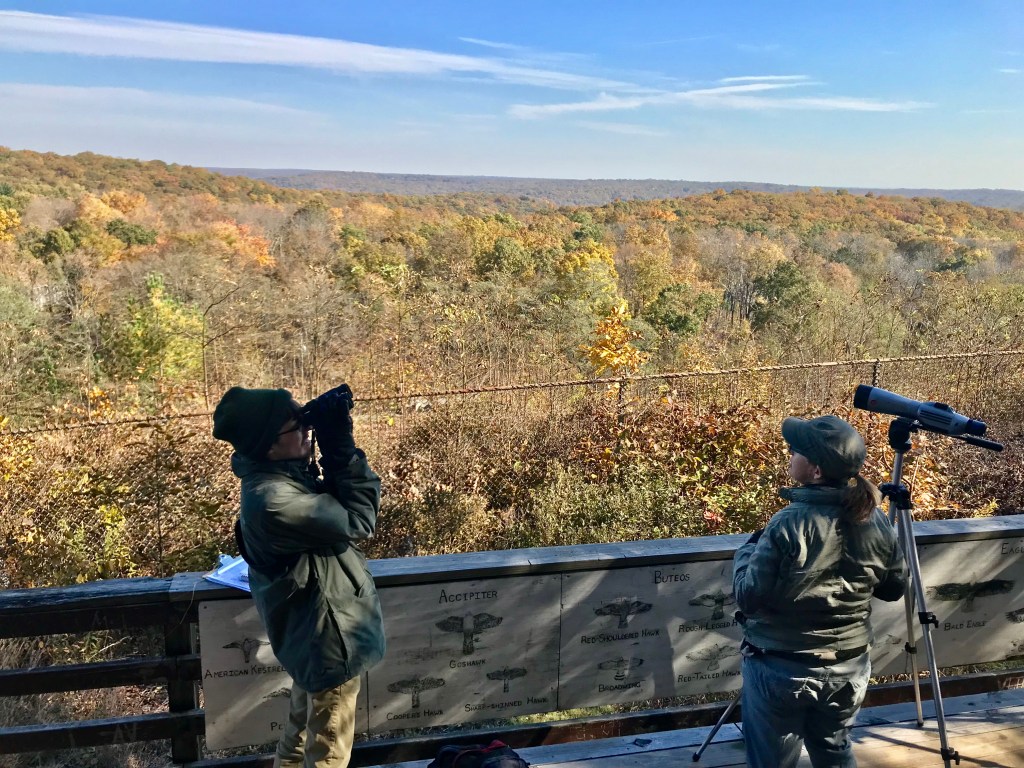
God’s still the finest painter around, and I love seeing the autumn collection. I followed the color palette north this week to stroll through some landscapes, and stumbled upon a fascinating find: a whole sub-culture of bird lovers, the Hawk Watchers. “ACROBATICS GOING ON IN THE V!” was the call that drew us in. When what to our wondering eyes should appear, but a platform of stadium seating perched high above I-684 in the middle of the woods, bleachers brimming with scientists and bird lovers rather than soccer moms. No kids on turf, rather a deep ravine and an unobstructed view from the foothills of the Taconic Mountains east to the Long Island Sound twelve miles away. “WE GOT SHARPIES IN THE MICROWAVE,” sent my mind running to a colorful explosion in my kitchen, but its meaning became clear when we received a tutorial.
Since 1982, mid-August to November 20, scientific data on raptor migration has been collected daily from 9am to 5pm at this stunning spot dubbed The Hawkwatch. It’s a joint project between the Nature Conservancy and the Bedford Audubon Society, part of a network of sites across the U.S. Located on Chestnut Ridge in the Butler Sanctuary, it consists of 363 acres owned and managed by The Nature Conservancy, its very first donated preserve (1954). From this humble beginning, The Conservancy became the world’s largest conservation organization, protecting over 119 million acres of land and 5,000 miles of rivers worldwide.
From a raptor’s point of view, Chestnut Ridge is one of many on the southward path of least resistance providing updraft and thermals, wind the birds use artfully for progress. The Sound acts as an invisible wall (they don’t like big open water), forcing the migration into an inland bottleneck directly over Chestnut Ridge. We saw about 30 big birds in 45 minutes, including a Bald Eagle. Birds seen here migrate from their northern breeding grounds of Quebec, the Canadian Maritimes and northern New England to their wintering grounds in the southern U.S. and Central and South America.
The Hawk Watchers have names for landmarks on the horizon so they can easily share the location of birds when spotted: The Gap, The V, The Microwave, Tallest Tree. There’s a mural on the stadium entitled “Know Your Silhouettes” with the names and shapes of raptors to look for, nicknames too (hence the “Sharpie in the Microwave”.) Binoculars and telescopes abound. “One glass” refers to the circular view in your binos rather than your whiskey order, such as “Osprey one glass up from the top of The Tulip.” We almost fit right in, but were outted by foliage when we yelled “FALLING LEAF AT 3 O’CLOCK!” Amateurs.
I had great fun connecting the dots of raptor watching sites in our area on Google Earth. From a bird’s eye view, there’s a clear pattern of helpful topography, a true and obvious Fly Way from north to south including:
Franklin Mountain
On the Delaware-Otsego Audubon Society Sanctuary overlooking Oneonta, NY, western edge of the Catskills. Noted for late fall flights of red-tailed hawks and golden eagles, it offers a panoramic view of the Susquehanna River valley and surrounding hills of Otsego and Delaware Counties.
I-84 Overlook
Feeds into the Kittatinny Ridge flyway (Raccoon
Ridge, Hawk
Mountain) but the flights are more
erratic. Hawks can be seen in the right conditions from the overlook atop
the Shawangunk/Kitattinny Ridge on the eastbound lanes of Interstate 84.
Bear Mountain
From its summit in the rugged mountains rising above the Hudson, you can see adjoining Harriman State Park, the state’s second-largest park. In fall, watchers use an overlook with views to the north and east; in spring, the summit near Perkins Tower with views to the south, west, and north.
Mt. Peter
Located at the north end of the Bearfort Range, Mount Peter is the highest point in Warwick, NY (1,253 ft) and is part of a broken, eroded, ridge whose narrowness and southwest direction effectively concentrate migrant hawks until they reach the lookout. Here they have two choices. Most take advantage of the height they have achieved over the lookout and strike out west/southwest toward the Kittatinnies. Others, especially eagles, pursue the ridge south down the west side of Greenwood Lake. However, south of the lookout the range spreads out considerably and updrafts and lift are lost. To the west is the town of Warwick and a rural valley that runs for approximately twenty miles to the Shawangunk and Kittatinny Mountains, part of the Appalachians. Westerly winds can race unchecked until they reached the flank of Bellevale Mountain causing updrafts. To the east is a narrow valley and Tuxedo Mountain.
Chestnut Ridge (in Butler Sanctuary as explained above)
Quaker Ridge (highest point in Greenwich)
In the Greenwich Audubon Center in southwestern Connecticut. Directly adjacent to the Kimberlin Nature Education Center, open daily from mid-August to mid-November, with an experienced hawk watcher on hand to answer questions. At the peak of this spectacle, the second weekend in September, the Center holds a Hawk Watch Weekend Festival.
Lenoir Wildlife Sanctuary
A 40-acre nature preserve in Yonkers, NY, owned and operated by Westchester County Department of Parks, Recreation and Conservation. The watch (weekends from Sept 1 thru Nov 30) is run by volunteers from the Hudson River Audubon Society.
If you’re snared, check out the following websites for data:
Hawkcount.org
HSAR.org (Hudson River Audobon Society)
Bedfordaudobonsociety.org
 My Suburban Escapes
Leave a comment