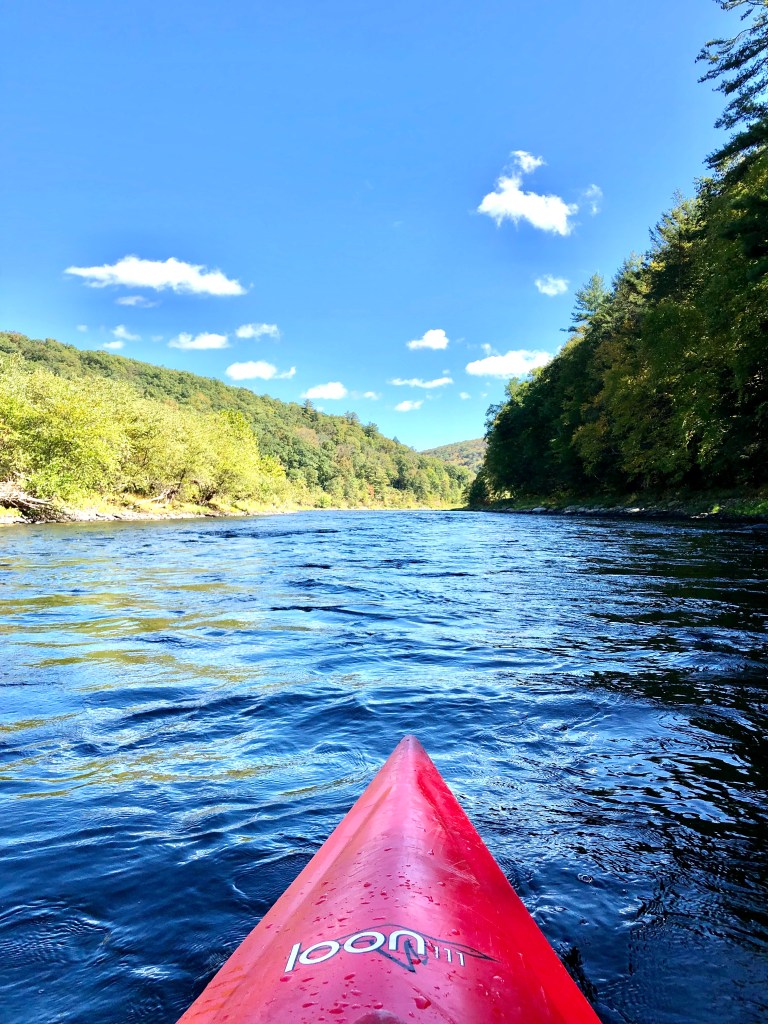
George Washington launched the Delaware into our national lexicon by crossing it on Christmas night 1776 to attack the Hessian troops occupying Trenton, NJ, turning the tide of the American Revolution. He was on the lower Delaware, the tidal portion which flows past Philadelphia and Trenton, Camden and Wilmington. The landscape changes dramatically from lower to upper at the Delaware Water Gap, where the river cuts through a ridge of the Appalachian Mountains. The river is as different in its North and South as is America.
It begins where the East and West branches cascade out of the Catskills to meet in the town of Hancock, NY. The “Upper Delaware” runs from this confluence 73 miles downriver to Port Jervis, forming the border between New York and Pennsylvania. The “Middle Delaware” is defined as the 40-mile Delaware Water Gap National Recreation Area, and the “Lower Delaware” as downstream from the Gap to the Atlantic Ocean at Cape May. It’s the longest free-flowing river east of the Mississippi, undammed for its entire 330 miles. More than 17 million people get drinking water from its 14,057-mile watershed. It’s home to mink, muskrat, beaver, white-tailed deer, wild turkey, owls, bobcats and otters. It hosts one of the largest populations of wintering bald eagles, and is chockful of heron and hawks. The East and West branches are renowned for trout fishing and for eel trapping, a fascinating phenomenon which has been a constant for centuries. Each summer the few fishermen fortunate enough to have permits construct weirs: two low stone walls, each about 300 feet long, that form a V pointing downstream to funnel the flow into a wooden trap at the vortex. Thousands of eels migrate downstream in September to spawn and die in the Sargasso Sea in the mid-Atlantic, many of which end up as a smoked delicacy in Hancock.
Giovanni da Verrazzano was the first European to explore the river in 1524, followed by Henry Hudson in 1609 in his trusty ol’ Half-Moon, describing it as “one of the finest, best and pleasantest rivers in the world.” Both were heartily welcomed by the indigenous Lenni Lenape people who ruled the Delaware from canoes dug out of poplar trees.
The 1800s saw timber rafting and coal barges take over the river. Rafting lasted only until the good trees were gone, and the last raft (built of inferior second-growth timber) floated in 1917. Another booming business was the mining of anthracite coal in the Pocono Mountains. The D&H (Delaware and Hudson) Canal and Gravity Railroad was built alongside the river and over it in the 1820s to connect the coal fields of northeastern PA to ports in New York and New England.
Timber rafts and barges competed for river space, but the 16 miles of gravity railway and 108 miles of canal with 108 locks created a very efficient system until the canal was drained in 1898.
Fast forward to the end of WWII. The Grumman Aircraft Company which made Wildcat and Hellcat fighter planes was left with warehouses of aluminum. While portaging his heavy canoe in the Adirondacks, a company engineer had the bright idea of making canoes with lightweight aluminum. Grumman began mass producing them for the recreational market, and the Delaware was once again ruled by canoe. Although fracking now looms as a potential threat, the river has been protected since 1978 under the national Wild and Scenic Act as a designated “Scenic and Recreational River.”
For now, canoes remain victorious.
The Upper Delaware by boat is stunningly beautiful, “Deliverance” without the danger. I passed through a cloud forest on the drive over then popped out into a whole new world. The rivers, streams, mountains, valleys and thermals of the Pocanos and Catskills offer endless adventure. The land knows not what state it is: New York, New Jersey, Pennsylvania. It’s all part of the Appalachian Mountain Chain from above. It’s so easy to get to and so close to Rye that there’s no excuse not to treat yourself. Just take a left (287 West), a right (684 North), a left (84 West) and a right exit to the river town of your choice. I’ve paddled it solo and with a group of teenaged boys, staying overnight in a cabin. I’ve done the Gap several times too, most notably when my young son got knocked off our packed raft and went floating downriver with a group of women in their summer burqas. Most city dwellers and tourists go to this section to raft and tube, and it’s just too packed for my taste.
But the Upper Delaware is all yours in the fall. I shared the river with eagles and hawks, only once “playing through” a raft full of city folk. All livery outfits on the Upper provide gear and shuttle only, no guides, so you’re blissfully on your own. No need to worry about dangerous rapids as the outfitters don’t run trips when the river gets above Class 1 & 2 rapids. You can always byo boat, but why? A $40 price tag frees you up from thinking/planning /running shuttle and floats their business.
If a drive is more your style, try the Upper Delaware Scenic Byway (Route 97) which parallels the river on the NY side for 71 miles and offers outstanding views. Begin in Port Jervis and head north. In Lackawaxen you can visit the oldest suspension bridge in
the country, the Roebling Bridge, and the former home of Old West fiction writer Zane Grey. You’ll pass through Hawk’s Nest in Deerpark, the most eye-popping gorge-eous spot on the river. If you paddle, outfitters abound. My recommendations are below. If you get as far north as Hancock, don’t miss eel trapper Ray Turner’s Delaware Delicacies Smokehouse. All you need is a little time to slow down and day trip.
Silver Canoe: http://www.silvercanoe.com
Indian Head Canoe (Great cabins in Barryville for an overnight.Pick up pizza at Il Castello if you’re packing light. 845.557.6400) http://www.indianheadcanoes.com
Kittatinny Canoes: http://www.kittatinny.com
Edge of the Woods Outfitters: (If you’re paddling the Gap.) http://www.watergapadventure.com
Delaware Delicacies Smokehouse 420 Rhodes Road, Hancock, NY.607.637.4443
 My Suburban Escapes
Leave a comment