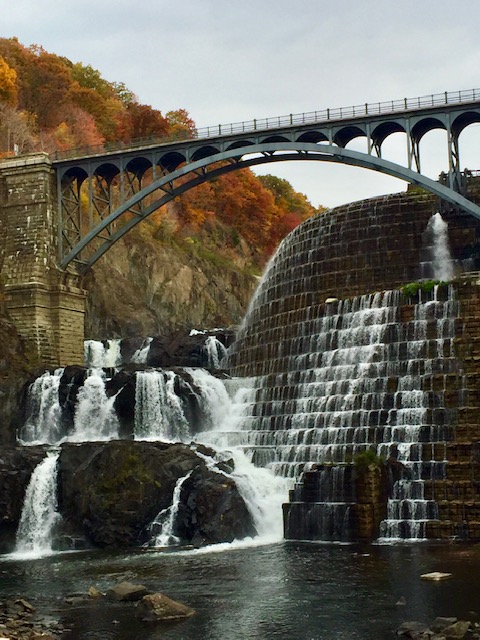
A marvel lurks just beneath the surface in Westchester.
The Old Croton Aqueduct. I hit the mother lode with this one. A walk on the OCA is one through the history of NYC, with something for everyone. Tales of Alexander Hamilton and Aaron Burr who were involved in early searches for water. Sojourner Truth whose church is along the path. Edgar Allan Poe who walked it regularly while living in the village of Fordham. Walt Whitman who opined the Aqueduct would outlive us all. The tale begins in a rural utopia and ends in urban chaos, a miasma of highways now circling the land through which it snakes across Westchester and into the Bronx: Cross County, Sprain Brook, Saw Mill, Henry Hudson and Mosholu, all named Parkways for a reason. Green space still abounds along the path, remnants from its pastoral past.
A dire need for water started it all. By 1830 NYC had become the most populous city in the hemisphere, although developed only from the Battery to 23rd Street. It was dirty, smelly, fire-prone and disease-ridden. Fire raged unchecked, the worst of which hit in December 1835, a huge wakeup call. Yellow fever was also a constant threat. But the cholera epidemic of 1832, which hit the city in late June, was the final straw. 3,000 people died by October and 100,000 had fled the city. The connection between clean water and disease control finally crystalized, prompting officials to renew and intensify efforts to find it.
In June of 1835, Major David B. Douglass was hired as chief engineer on a plan to bring water from the Croton River. He began with a land survey along the project line. Although rural and undeveloped, it was inhabited by about 200 landowners who would need to be compensated or displaced. He was tasked with visiting all of them. In the end, the City paid $165,786 for 813 acres of rural Westchester land.
Douglass’ plan became so mired in controversy over imminent domain that he was fired and replaced by John B. Jervis in October 1836. Jervis picked up where Douglass left off, using his planned route, structures and hydraulic principles. The issues to tackle were capacity, source and transport, none small feats. No one had ever undertaken such an immense project. Big corporate enterprise didn’t exist, nor did big government. Jervis, an engineering genius with no formal training, had cut his teeth on the Erie Canal. He completed the aqueduct in 5 years for $9 million, the greatest engineering feat in antebellum America.
Capacity: The goal was set at 9 million gallons per day: 20 gallons per person for the population of 450,000. But none could foresee the Civil War and the wave of immigrants to follow. From 1850 to 1900, Manhattan’s population quadrupled to nearly 2 million. The Aqueduct, planned and built to last a century, would be obsolete by 1883, 41 years after opening.
Source: Jervis chose a spot on the Croton River, 7 miles upstream from the Hudson, to build the first big masonry dam in the country, creating a 400-acre lake from which a gravity-fed conduit, based on Roman design principles, would transport the water to the city. Electricity was not yet invented (1879), so pumps were not an option. The plan was to construct the Aqueduct on a constant slope of 13 ¼ inches per mile. The topography of the Hudson Valley was wildly uneven, so methods had to be devised to keep the flow constant. Bridges, tunnels, culverts and embankments were created, achieving the effect of a teacup perched on a lady’s head and not spilling a drop.
Transport: Jervis divided the project of building the 41-mile tunnel into four 10-mile long sections, each managed by a resident engineer. Dynamite had not yet been invented (1867), so the tunnel would lie just a few feet beneath the surface in a shallow trench. Irish immigrants were hired in droves to dig and build, living in camps along the project line and earning about 80 cents a day. Construction began in 1837. The Aqueduct was set on a stone foundation and covered with dirt. Its interior was 7½ feet wide by 8½ feet high, lined with brick and stone adhered with waterproof hydraulic cement. 33 ventilators were built at mile intervals to provide air circulation and tunnel access for repairs.
The Aqueduct followed the line of the land, meandering along the Croton Gorge to the Hudson River where it turned south, doglegged east in Yonkers across the Saw Mill Valley then continued south along Tibbetts Brook Valley, onto the Fordham Ridge and to the Harlem River, it’s greatest natural obstruction. After much debate, they built The High Bridge to transport the water across the Harlem, a viaduct tall enough to accommodate boat traffic.
On the Manhattan side, it continued southward from W. 173rd down Amsterdam Avenue into Central Park at West 85th, and into the York Hill Reservoir, a 31-acre, 180 million gallon holding tank (demolished in 1900 under the direction of Robert Moses to become The Great Lawn). It then continued over to East 80th and down Fifth Avenue to its terminus between 42nd and 40th streets into The Murray Hill Reservoir, a 24-million gallon distributing tank, from which it was piped all over the city. It too was demolished in 1899 to make way for the New York Public Library.
The first water entered the Aqueduct on June 22, 1842, arriving at the Harlem River 22 hours later and eventually filling the two reservoirs. The water spewed out of the fountain at Murray Hill to great fanfare, like oil from the Texas plains.
The Westchester section of the OCA was designated a National Historic Landmark in 1992 and is great to walk or bike. Excellent maps can be found online at www.aqueduct.org or from the Friends of the Old Croton Aqueduct at the Keeper’s House, 15 Walnut Street, Dobbs Ferry, NY. 914.693.4117.
You can still walk or bike most of the route above which the aqueduct lies. Bikes can be rented at Endless Trail Bikeworx in Dobbs Ferry.
 My Suburban Escapes
Leave a comment