One of the prettiest little rivers in the county, the Croton, packs a surprising whallop: it supplies 10 percent of New York City’s 1 billion gallon a day usage. Like the late Ruth Bader Ginsberg, “Though she be but little, she is fierce!” First dammed in 1842, the Croton was tapped again and again as NYC’s water needs increased. The Old Croton Aqueduct gave way to the New in fifty years, half the time projected for the growing city to require more water. A 300-foot high masonry dam was completed in 1906 to create a 16-mile reservoir capable of storing 14.2 billion gallons. It still spans the river just above Croton-On-Hudson and is a great spot to kick off an excellent mini adventure.
There’s a lovely clearing at its base, the 97-acre Croton Gorge Park, from which you can watch the water cascading over the dam. It’s a county park and can be crowded on weekends so plan accordingly. It is also where the Old Croton Aqueduct Trail begins its curvy route to NYC (see blog dated March 5, 2020: Ye Olde Croton Aqueduct), but it’s easier to pick up its path a little further South. Choose instead the lovely trail starting by the playground which rambles through the woods to the right of the dam and leads to its top. Rules of (un) civility have dictated changes in exploration, but walking along the dam is still allowed. Return on the same path or you’ll end up on busy Route 129.
For a “from both sides now” experience, drive 5 miles south to the Croton-on-Hudson train station where the Croton converges with the Hudson. A train trestle is all that divides them, and the mighty waters of the Hudson rush in and out twice daily to fill and deplete the shallow mouth with the tide. If you’ve driven north on 9 from Sleepy Hollow, you’ve crossed the mouth of the Croton and probably never noticed.
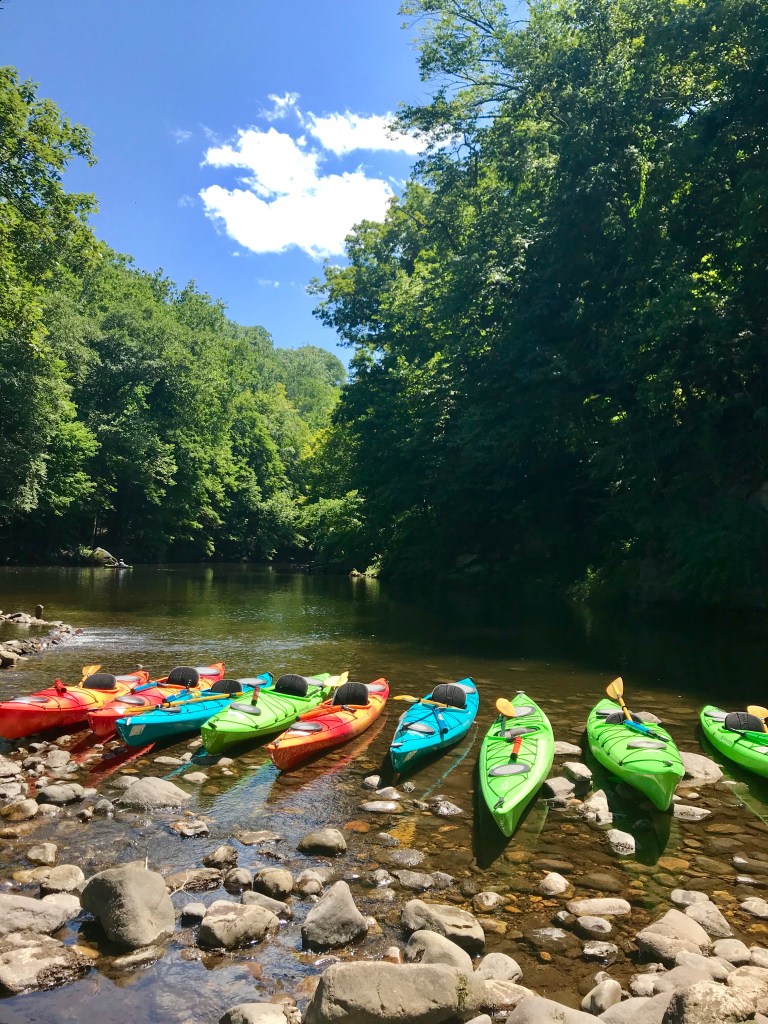
There is a kayak rental place at the south end of the station parking lot, but Covid has scuttled its operations for now. If you byob (bring your own boat), you are welcome to launch and park in the small lot by the put-in (free) or at the train station (paid). Two hours on either side of high tide is the best time to paddle as it becomes a mud flat at dead low. During those magic 4 hours you can paddle into another world edged by marshes and overhanging willow trees. Dragonflies are buzzing and fish are jumping. The route is obvious and easy. The water is cold and clear as it comes from the bottom of the deep reservoir. Or you can paddle under the trestle into the Hudson if the tide is low enough to check out Croton Point Park, a 508-acre county park on the peninsula to your right. The oldest oyster shell middens on the North Atlantic Coast were unearthed here by archeologists, confirming that it was inhabited by Native Americans as early as 7,000 years ago. Croton Bay is super shallow at low tide allowing you to beach your boat on the sand bars and take in the beauty of Sleeping Indian Rock across the Hudson.
The Van Cortlandt Manor, home of The Great Jack O’ Lantern Blaze, is also on the Croton. You’ll see an inlet on your left, just west of Hwy 9, which you can paddle up to explore. As you continue upstream, an island separates the river but either direction around it is fine at high tide. Go left around it if the tide is low. You’ll see homes on the cliffs overhanging the river, a few docks, and a rope swing or two. Take out for lunch at the second big island where the river tumbles down through cold rocky streams on either side. This is the end of your journey and the reward is great. I love to walk the path up the island’s center, jumping over boulders, climbing trees and building dams. Sturdy river shoes or old sneakers are best. Head back the way you came, feeling like Huck Finn, and reward yourself with homemade ice cream at The Blue Pig at 121 Maple Street in Croton-on-Hudson.
“No man ever steps in the same river twice,
for it’s not the same river and he’s not the same man.”

 My Suburban Escapes
Leave a comment