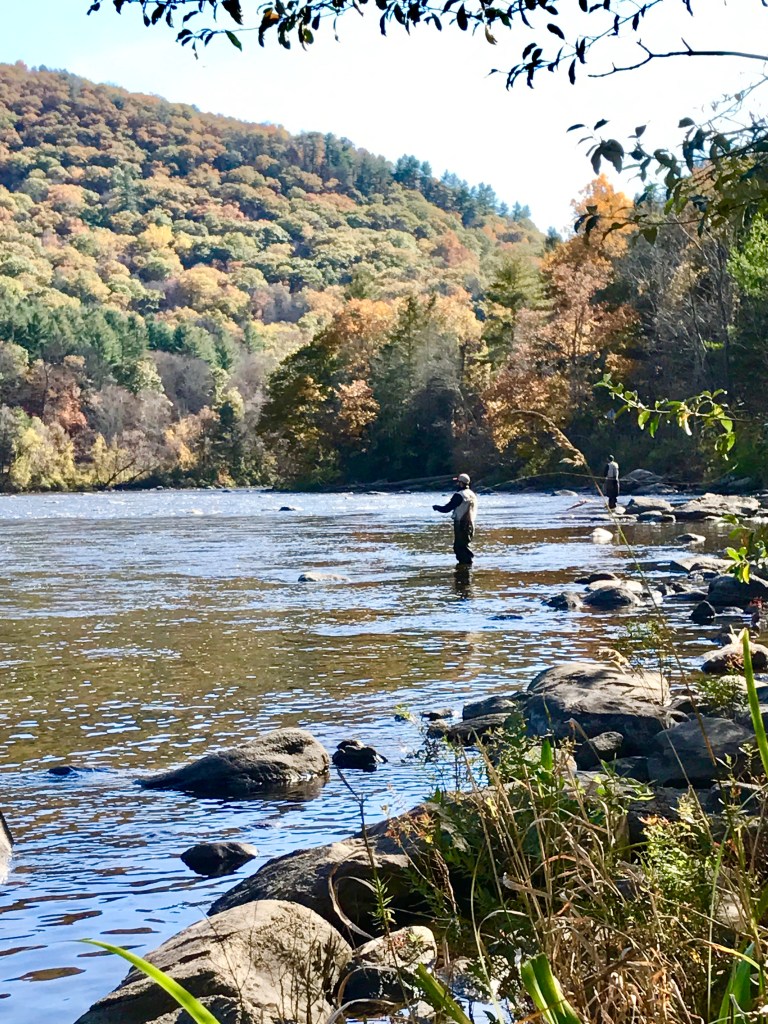
I’ve got three words to sum up the art of fly fishing: “Be the bug.” I gave it a go this fall and the first thing I learned was to abandon everything I know about a rod and reel. A fly rod is totally different. Hold it with your right hand instead of your left. Pull the line in manually with your left hand (no right-hand reeling) and let it drop on the water. Keep your tip level to the waterline rather than up. Cast back and forth repeatedly before dropping the line.
When used correctly a fly rod is truly an extension of your arm. The goal is to bend your elbow, not your wrist, and karate chop back and forth with a maximum 45-degree angle on the back “load.” Aim to keep the back and front cast equal in force as any variation changes the position of the rod. Your goal is to find the balance. Trout fishing is a very Zen sensation whether you get a bite or not.
Your best bet as a newbie is to hire a seasoned guide with gear and study him or her all day. A life-long fisherman fishing is a thing of beauty and grace. Your job is simple in theory: determine how the fish are feeding. The idea is to “match the hatch” aka determine what kind of bugs are hatching and make your lure (fly) look and move like them.
The pristine waters with incredible bug life of the Catskill Mountains is a great place to begin. They are known as “the birthplace of dry fly fishing in America” with Theodore Gordon at the helm. Gordon began the movement in the 1890s, creating new flies specific to the region. It peaked in the 1920s, tanking during the Great Depression like so many other recreational pastimes. Interest returned in the 50s when bamboo rods were replaced by inexpensive fiberglass and synthetic line, then another bump in the 70s when graphite rods hit the market.
The lingo is my favorite part. There are wooly boogers, copper johns, squirmy wormies, chubby chernobyls, mops, sculpins, caddis, stonefly, blackfly and mosquitos. Here’s a typical monologue (although most fishermen prefer to enjoy the silence): “ I’m gonna grab one of my high floating chubby chernobyls and tie it onto my tippet – just the normal way – then put a piece of tippet on the bend of the hook with a cinch knot. I usually use fluorocarbon because that sinks a little better than nylon, so it’ll help that nymph sink a little better.” Translation: I’m gonna be the bug.
It’s alot to take in all at once, but here’s what you’ll need to get started:
- NY fishing license: Purchase at www.dec.ny.gov (Department of Environmental Conservation) or in person at Extreme Archery in Mamaroneck. Check the DEC website for free fishing days (no license required) if you just wanna dabble. Each body of water has special regulations.
- Waders or boots: Don’t use the old ones kicking around your equipment shed. Waders need spikes (corkers) or felt on the bottoms as you’ll be navigating slippery rocks. Felt can transfer bacteria river to river so do your research.
- Polarized Sunglasses: To cut the glare on the water so you can see fish and rocks.
- Dry bag: You don’t want a wet phone, keys and lunch and you’re likely to fall. Use a waterproof back, shoulder or fanny pack as you’ll need both hands to steady yourself.
- Shirt with pockets: Ready access to hemostats, clippers, weights, dry powder and flies is helpful. Your guide will carry all this until (if) you’re ready to do it on your own.
- Wading stick (walking stick or ski pole) to keep your balance.
You can fish on a fly for anything on any body of water all year long – stream, saltwater, river or spey. You just fish em differently. Dry flies and streamers and nymphs…oh my! With dry flies you pop the top of the water repeatedly, mimicking a bug buzzing around and treating the fly with silica to keep it afloat. Streamers are sunk then reeled in and are made of expensive materials for very diverse hatches. Nymphs require an indicator, a floater just big enough to keep the fly on top of the water but not to make a big splash and scare the fish. Salmon and steelhead require a lot more effort and heavy gear – power fishing. A figure 8 or butterfly cast is required in speys (Scottish waters where fly fishing originated) as the waters are tight. On the Mississippi they fish the borrow pits (holes from which dirt was removed to build the levees) for bream and bass. In short, the waterway and hatch determine technique. The possibilities are endless.
Start close to home. Research the Catskill waters of the Beaverkill, Neversink, Willowemac and Delaware Rivers; Esopus and Roundout Creeks and Batavia Kill. Check out the Farmington and Housatonic Rivers. Many waters are catch-and-release which confuses a redneck like me. But hey ho. When in Rome and all that. Since you’re not gonna eat it, treat it right. The less you hold it the better as handling removes its protective slime. Try to keep it in the water when removing the hook. And don’t stress it out more with selfies.
SOURCES:
- Wulff School: On the Beaverkill River in the southwest corner of the Catskills. Leading pioneers Joan (a former dancer whose grace is obvious in her casting) and husband Lee (inventor of the fishing vest) Wulff opened the school in 1979. Joan’s words are gospel:
“Fly casting is different from all other sports in that it requires two strokes instead of one. Because the weight we cast is the long and flexible fly line, it must be unrolled with force backward as well as forward. Your first challenge is to develop backward-throwing muscles.”
Watch her video “Dynamics of Fly Fishing: Chapters 1-4” on their website then practice with a washer or a ball of yarn on the end of a cotton string tied to a 6ft bamboo stick.
- Orvis: Sandanona in Millbrook, for guidance; Ridge Hill in Yonkers for gear
- Upcountry Sportfishing on the Farmington River in New Hartford, CT. Guide Mark Swenson marcus2@charter.net. (203)632-0206.
- Housatonic River Outfitters in Cornwall Bridge, CT
- Orvis-endorsed guide Ray Ottulich guides in the Catskills (rayottulich@rayottulich.com)
- Michael Healy guides for steelhead and salmon on the world-famous Salmon River near Pulaski, NY. Mrhealy999@gmail.com. 845.608.3299. Instagram, healy_outdoors. Stay at the Tailwater Lodge in Altmar, NY.
- LL Bean: If you’re in the mood for Maine
- Bass Pro Shop: Check out gear at the Bridgeport, CT, store
- Catskill Fly Fishing Center and Museum in Livingston Manor, NY (www.cffcm.com)
- American Museum of Fly Fishing in Manchester, VT (www.amff.com)
- Roscoe, NY, “Trout Town USA”: Home to the famous Junction Pool where avid anglers find prime fishing at the confluence of the Willowemoc and Beaverkill Rivers.
- http://www.thenewflyfisher.com
Special thanks to Rob Healy for educating me on the fly.

 My Suburban Escapes
Leave a comment