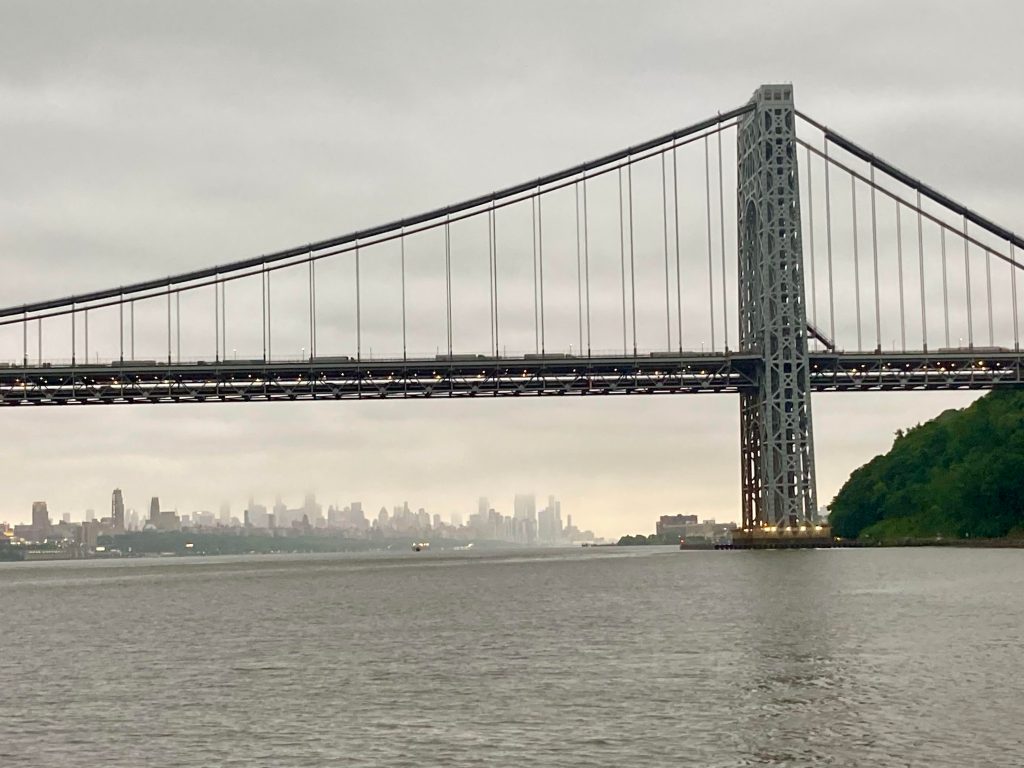
I was recently asked to be a new friend’s “plus one” at a fancy soiree and by accepting discovered a whole new world. It was a dinner celebrating the work of the Palisades Parks Conservancy (PPC) and the Palisades Interstate Park Commission (PIPC) held at Ross Dock on the Hudson River, nestled beneath that sheer wall of beauty called the Palisades with a spectacular view of the George Washington Bridge and the Manhattan skyline. The PPC supports the work of the 10 commissioners of the PIPC – ten individuals from NY and NJ who voluntarily serve through fundraising. The party was packed with descendants of folks whose names I see all over things I love and things I read. Harrimans, Welches and Perkinses abounded, as it was the vision and hard work of their ancestors which saved these cliffs. It was their moment to shine. I was star-struck and speechless, so I grabbed my champagne, kicked off my shoes and rambled around the grounds to watch a glorious storm blow in. Here I was, smack dab in the middle of this age-old jewel I had so often admired from the other side while dreaming of westward escape. Like a bug caught in amber, I was finally IN the “White Cliffs of Jersey.”
This Magic Rocks kingdom spewed forth from the earth’s core about 200 million years ago, right around the time the Americas broke away from Europe and Africa and opened up the Atlantic Ocean. Millions of years later the Dutch broke away from Europe and crossed the same ocean to explore a new land via this river. And a hundred years after that a new America broke away from England and traversed these cliffs in their battle for freedom. By the turn of the 20th century, efforts were underway to blast the cliffs and barge the rock across the river for the construction of a rapidly growing city. The noise and desecration alarmed several wealthy New Yorkers including JP Morgan and John D. Rockefeller, Sr, who urged the governors of NY and NJ (Theordore Roosevelt and Foster Voorhees) to protect the Palisades. The PIPC was formed in 1900 and led by George W. Perkins who set about purchasing land and removing the quarries and industrial buildings. The PICP began to cobble together Harriman and Bear Mountain parks and hired Major William Adams Welch to design and build the parks’ infrastructure and 103 children’s camps for local and inner-city children. Outdoor nature education programs were set up, including the first section of the Appalachian Trail and the Trailside Zoo at Bear Mountain, both of which you can visit today. Through the years the PICP continued to lead grassroots efforts to protect much of the parkland at risk and became the Palisades very own knight in shining armor.
The Palisades Parklands is comprised of 130,00 acres in New York and New Jersey and includes 20 parks and 8 American Revolution sites. Bear Mountain, Blauvelt, Bristol Beach, Franny Reese Preserve, Goosepond Mountain, Harriman, Haverstraw Beach, High Tor, Highland Lakes Park, Hook Mountain, Lake Superior, Minnewaska Preserve, Nyack Beach, Palisades Interstate Parkway, Palisades Park, Rockland Lake, Schunnemunk, Sterling Forest, Storm King and Tallman Mountain are all in the same parklands system. I have visited most of these and had no idea they were part and parcel of those beloved white cliffs. And it’s all right here, hiding in plain sight.
The “White Cliffs of Jersey” are in Palisades Park. The very road you take there is a work of art, the Palisades Interstate Parkway, which runs the 42 miles between the George Washington Bridge and Bear Mountain. It was designed and constructed by major engineering and landscape architects of the day and completed in 1958 to give city folk easy access to the beauty of the countryside. It runs along the top of the cliffs, while the Henry Hudson Drive runs down along the river. One of the oldest scenic drives in the nation, Henry Hudson Drive passes through the woodlands below the cliffs from Fort Lee to Alpine and is a perfect “Sunday stroll” (although less crowded on weekdays). I took 287 to 9W south to the Parkway, careful not to accidentally cross over the GW Bridge as it is right by the entrance to the Henry Hudson and under construction. It’s confusing, congested and angry. The minute you make the turn, the world changes. You leave urban hell and are immediately under the GW on a small country road along the river. Packs of cyclists from NYC frequent this route, crossing over the GW and biking up to Piermont and back. This magic rectangle of land is hemmed in by the river, 9W, the GW and the Tappan Zee bridge for a total of 15.7 river miles. It is Stage 6 of the “8 Bridges Hudson River Swim”, the penultimate section in this swim to the city from north to south. You’ll discover Ross and Hazard’s Docks, Alpine and Englewood boat basins here. Greenbrook Sanctuary nearby is members only, but well worth the annual fee of $35 for access.
For best exploration along the top of the cliffs, park at Allison Park where you can access the Long Path trails, or at the State Line Lookout which also has access to great hiking and 5 miles of cross-country ski trails. The Visitor’s Center and bookstore, exit 17 on the Palisades Parkway, is a great place to get maps and books to plan your adventure. Or explore online before you go at http://www.njpalisades.org or www.palisadespark.org. It’s a lot of land to cover but baby steps and research will set your course. It’s the very heart of our nation. Do yourself a favor and join the 9 million annual visitors. Consider it your patriotic duty.
 My Suburban Escapes
Leave a comment