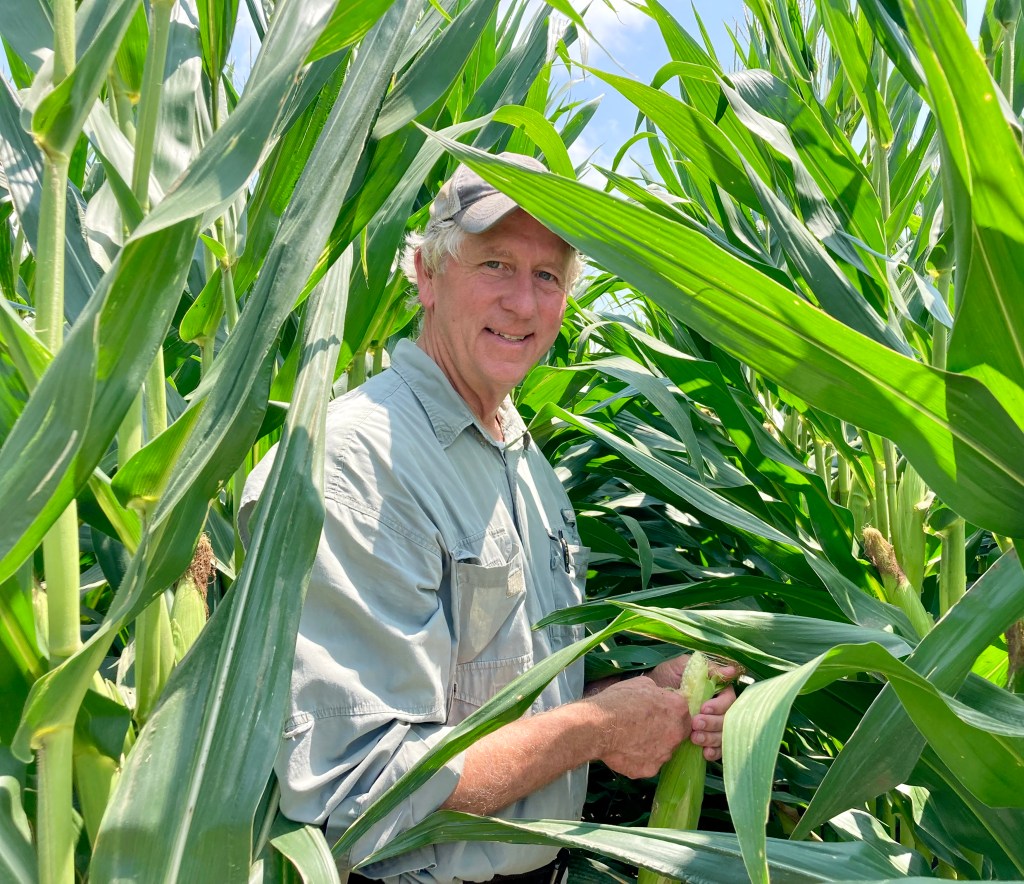
I seem to have a knack for looking out the plane window just as we fly over the Mississippi River. It draws me like a magnet and heralds me home, my personal Mason-Dixon line. From the air the land looks like a patchwork quilt of earth tones and textures: deep browns and crisp greens in perfect squares as far as the eye can see. On the drive through the Delta, its rows and rows of crops flanking the highway and rushing by like an animation flip book. And when you finally slow down and stop, it’s a bunch of plants in the rich soil with a man in the middle of it all…in his truck…on his phone.
My brother-in-law, Tap, farms 15,000 acres of cotton, corn and soybeans on two separate operations in the Delta – one on a bend in the Mississippi River in Lake Providence, Louisiana, and the other thirty miles northwest near Parkdale, Arkansas. His truck is his mobile office, his daily commute being 1 ½ drive from his wife and home. He loves what he does, so the drive time is hardly a bother. His job is dictated by weather: too little or too much rain and sun shape his year which typically goes like this:
Early March (by the 10th): plant corn as it needs low temps to pollinate
Late March to early May: plant soybeans
Late April to early May: plant cotton
August to September: harvest corn
August to October: harvest beans (uses same machine as corn)
September to October: harvest cotton
The goal is to finish planting by the end of May, then maintain the crop ‘til harvest. Provide water and light, remove bugs and weeds. It may sound simple, but there’s a whole lotta know-how poured into those fields, knowledge learned by doing rather than in a classroom.
Lack of water is usually not an issue – Delta fields are highly irrigated – but flooding certainly is. The Mississippi has breached twice nearby, once notably in 1927 and again in 2011, ruining tens of thousands of acres of farmland in the blink of an eye. The river’s main character is to meander, leaving oxbow lakes in its path and devastating man. Sunlight is plentiful, as are bugs and weeds. A crop consultant provides an Integrated Pest Management (IPM) report weekly and assures that pesticides are only applied when and where needed. Tap rotates his crops for both agronomic (varying soil content helps eliminate certain diseases and depletion of the soil) and economic (commodity prices) reasons. He also manages and consults for AgVictus, a private equity firm in Atlanta, on their Delta properties in Louisiana, Mississippi, Arkansas and Missouri. He fell into this organically around 1998 when a farmer friend asked his advice, and the asking never stopped.
Tap was born to farm. His parents had purchased 200 acres just before he arrived and farmed it for 12 years when his father passed suddenly. His mom then provided for the family by leasing out the land. Tap dutifully studied Agricultural Business at Louisiana Tech then hurried home asap to begin farming those precious 200 acres. He now owns 2,000 acres, farming an additional 13,000 acres leased from neighboring landowners. He has served on the Cotton Board, is a delegate to the national Cotton Council and was recently appointed Chairman of the venerable company Staplcotn, the largest cotton cooperative east of the Mississippi. In these respects, his career is not that different from many up here in the big city. Technology has altered his job as it has everybody’s. Thankfully his son speaks the new language and is now farming with him, having recently graduated with degrees in Ag Engineering and Agronomy. His mad skill as a drone pilot is a radical departure from driving through acres of fields to check on crops, and his videos and pics are amazing.
I recently passed a day on the farm during Corn Camp, a tradition started around 1990 during which a half-acre of the 6,000 acres planted is pulled by hand by the South African crew while still in the “sweet corn” phase. They shuck it, bag it then drop it in the kitchen where its “put up” for the year by family and friends. I bent my own ear to the words of wisdom floating around that farmhouse while we cleaned, cut off kernels, cooked, cooled and canned about 5,000 ears. Here’s some of what I learned….
*Each corn stalk produces one ear. When it sprouts, a tassel pops out at the top of the stalk to do the pollinating. The silk at the top of the newly-forming ear catches the pollen, then disperses it to each kernel through an individual strand.
*Most soybeans are used to feed livestock (mostly poultry), but beans are also used for human consumption in tofu, soy milk, edamame, and cooking oils as well as in crayons, biodiesel, paints, building materials, cleaners and lubricants.
*Growing cotton is an art. Unlike with corn and beans, your efforts can make a difference and are reflected in the final crop. “You can alter yield throughout the entire growing process through management and timely application of nutrients, insecticides and growth regulators – a non-toxic material which causes the plant cells to focus on the boll rather than the green part of the plant.”
This summer when you towel off after you dip in the pool, pull on a soft cotton T-shirt then bite into that corn cob hot off the grill, give a quick think on the effort that went into it. And a silent “thank you.”


 My Suburban Escapes
Leave a comment