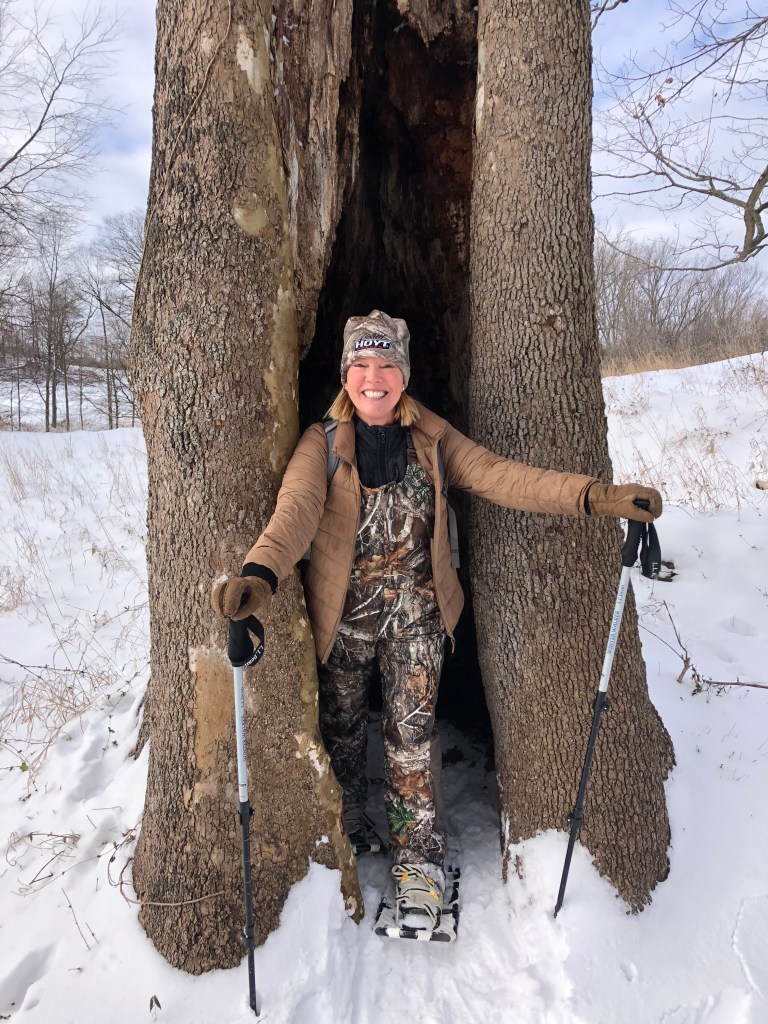
It was thoughtful of the winter gods to give us a parting gift right before March roared in. That (hopefully) last snowfall was perfection, like a robin’s-egg blue box with a big white bow on top. Everyone was snug as a bug in a rug before it hit, plenty of snowplows standing by to clear the road and a blank slate of pure white upon which to metaphorically write. I chose the snowy woods of Rockefeller State Park Preserve where I got to lay down the first tracks of the day.
Mondays are the best for adventure, when the weekend warriors have all gone home. I began on the aptly named 13 Bridges Trail re-enacting Robert Frost’s “The Road Not Taken” and ended when dive-bombed by big fat snowballs falling off the trees as the sun came out. I had 1,700 acres of forest, field and stream all to myself.
This swatch of land in the Pocantico River watershed is full of rolling hills running to the Hudson River. It’s all part and parcel of the former estate of John D. Rockefeller, founder of Standard Oil and the nation’s first billionaire. He collected about 3,500 acres of it over the course of seven years (1893-1900) to create his country estate, Pocantico. His ancestors graciously endowed the land after their time on it to the State of New York so that future generations could enjoy it as they had.
John D. chose the Hudson Valley at his baby brother Bill’s behest. William Avery Rockefeller, co-founder of Standard Oil, had purchased 200 acres with an existing homestead in 1886. He encouraged his brother to do the same while land was still available. He rebuilt the house, Rockwood Hall, to be one of the largest in America, second only to the Biltmore in North Carolina.
John D’s first purchase in 1893 was 250 acres on the highest point of the Pocantico Hills overlooking the Hudson. He soon began building his Georgian manor with the help of his son (John D. Junior) who closely managing the design and construction. Completed in 1903, it was dubbed Kykuit, the Dutch word for “lookout.” Father and son purchased or built more than 60 structures over the years including a 9-hole golf course, a playhouse with indoor and outdoor pools, tennis, squash and basketball courts, a billiard room and bowling alleys for his family. But one of John D’s proudest moments was when the family chose his design for landscaping the grounds over one drawn up by Frederick Law Olmsted (designer of Central Park.) An excerpt from his memoirs reads:
”I had worked out a plan so devised that the roads caught just the best views at just the angles where in driving up the hill you came upon impressive outlooks, and at the ending was the final burst of river, hill, cloud and great sweep of country to crown the whole, and here I fixed my stakes.”
This experience is still what one shares today whether on foot, snowshoe or horse. 45 miles of carriage trails of crushed stone lead to shady river lanes, intimate wooded paths and panoramic vistas. All yours for the taking.
The estate would eventually house four generations of Rockefellers. John D and his wife Laura Celestia (“Cettie”) Spelman had five children: Bessie, Alice (died in infancy), Alta, Edith and one son, John D Junior. Junior married Abby Aldrich in 1901 with whom he had 6 children: Abby (Babs), John III, Nelson, Laurance, Winthrop and David. Most lived on and were involved with the estate.
But time marches on. William passed away in 1922 and Rockwood Hall was converted into a series of country clubs, gradually falling into disrepair. Junior acquired his uncle’s estate in 1937 and razed the house in 1941, dumping the pieces into the Hudson River as was then the custom. He spared the foundation, roads and landscaping by Frederick Law Olmsted. The land eventually went to Junior’s son Laurance who sold a parcel to IBM to pay taxes on the rest. IBM sold to New York Life which sold to Regeneron which is there now. The remaining parcels were sold to New York State for a song, with the last 33 acres donated in 1998 to become part of Rockefeller Preserve.
John D passed in 1937 and Kykuit became Junior’s family home. His son Nelson bequeathed his one-third interest upon his death in 1979 to the National Trust for Historic Preservation, which opened the way for preservation and public tours. Rockefeller families still live on the estate, in the central compound and beyond.
The preserve consists of four sections:
Swan Lake: The scenic heart. Brothers’ Path is the gateway.
Buttermilk Hill: The eastern section overlooking the Sawmill River Valley (now the Sawmill Parkway, alas).
Eagle Hill: The western section crisscrossed throughout by the Pocantico River and Gory Brook.
Rockwood Hall: Offers grand vistas of the Hudson River and Palisades, spacious grassy fields, magnificent old Copper Beech trees and massive rock walls and terraces. Best sledding hill in Westchester.
If the woods aren’t for you, check out Union Church, a Gothic Revival built by Junior in 1921. When his wife Abby passed in 1948, their son Nelson had Henri Matisse design windows in her honor. When Junior died in 1960, his children commissioned Marc Chagall to design a window for him.
And don’t miss Stone Barns Center, a not-for-profit farm and education center offering a unique experience: “the opportunity to learn about agriculture firsthand on a working farm and build connections to the food we eat.” Stone Barns was the brainchild of Junior’s youngest son David and his daughter Peggy Dulany, and another example of how the Rockefellers shared their land.
Rockefeller State Park Preserve:
125 Phelps Way (Rte 117), Pleasantville. 914.631.1470.
Begin here by getting a trail map at the Visitors Center.
Dogs allowed on leash.
Rockwood Hall:
Take Phelps Way (Rt 117) West til it deadends into Rockwood Road. Park in small lot on the left, just past the Phelps Hospital and Regeneron signs. Cross the road and head uphill towards the river. Best sledding hill in Westchester County.
Union Church:
555 Bedford Road, Tarrytown. Call 914.4.366.6900 for a tour.
Stone Barns:
630 Bedford Road, Pocantico Hills. 914. 366.6200.
Don’t go when there’s an event or on weekends unless you like it chockfull of city folk yearning for that “firsthand experience.”
Lunch at Blue Hill Café, and reconnaissance for a nice dinner at the famous Blue Hill Restaurant.

 My Suburban Escapes
Leave a comment