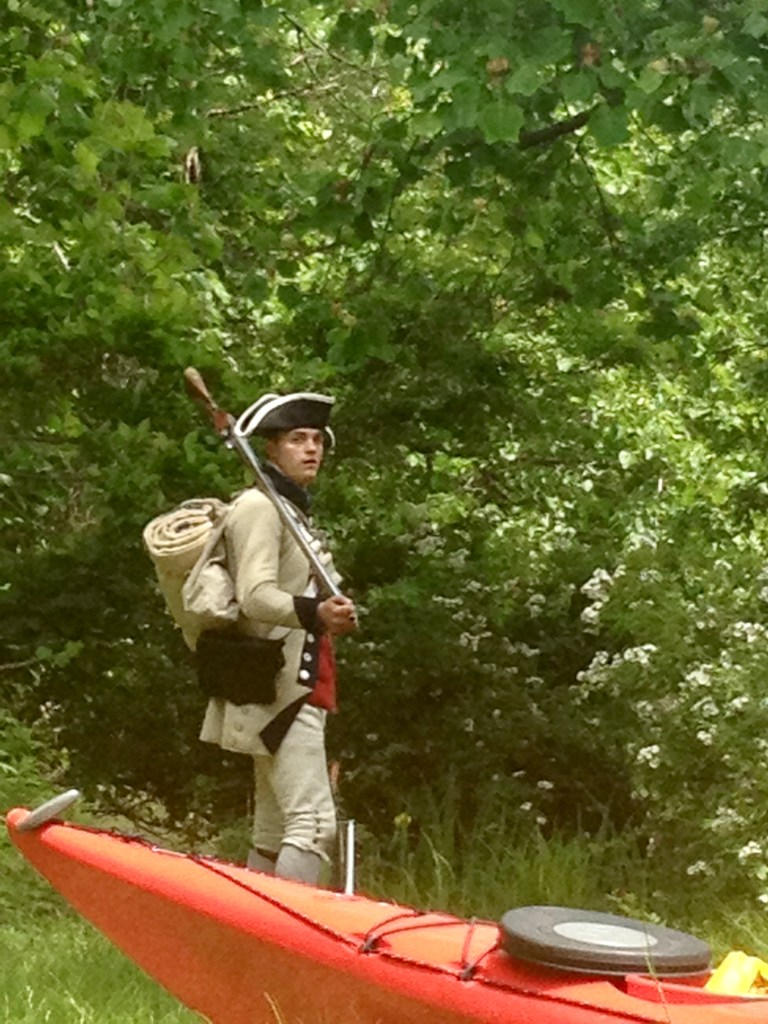
So this is Christmas. And it’s tainted by disease and politics. And its been hard.But chin up. I share a tale of another Christmas tainted by disease (smallpox) and politics (the American Revolution) which may help put things in perspective. I bear glad tidings: our founders prevailed, as shall we. In my ramblings I’ve covered the entire route of the revolutionaries’ retreat from Fort Montgomery to Washington’s Crossing, Pennsylvania. It’s only about 110 miles, but they had already been chased all over Long Island and up the 52 miles from lower Manhattan to Bear Mountain where they skedaddled across the Hudson. By the time winter arrived, many were in rags and shoeless. As I followed their path, I thought about these rebels every step of the way, marveling at what they accomplished against all odds.
General George Washington well knew that whomever held the Hudson River at New York during the revolution “controlled the safety of America,” hence much of the early action was centered there. They played a grand game of Capture the Flag with troops advancing and retreating constantly, referred to in warspeak as the New York/New Jersey campaign. The next natural barrier was about fifty miles west, the Delaware River, which separated New York and New Jersey from Pennsylvania. This is where our story of Christmas Past begins.
It’s nothing short of a Christmas miracle that we have a country at all. By the winter of their discontent, the revolutionaries were running low on supplies and morale and high on desertions and misery. They had lost their hold on New York and retreated across the Delaware. The fighting had begun in April, and by July Britain had sent over half of its army (34,000 troops) to quash the insurrection. Our citizen soldiers were pitted against the world’s strongest military, a third of whom were mercenary Hessians – well trained, well equipped and well paid. They waged war all around New York: Brooklyn, Fort Washington, White Plains and the Jersey Palisades. Our rebels fought hard and fought well, but by December they had dwindled from 7,000 to 3,800. They were badly beaten, outflanked and demoralized. Only half the colonists supported the war and a third fought for the British, pitting neighbor against neighbor. Enlistment terms were about to expire on January 1, lawfully freeing all soldiers. The rebellion seemed doomed. Unless Washington could pull a Hail Mary.
As our weary heroes huddled around campfires under the falling snow, they read a pamphlet dropped into their camps like a gift of the Magic, “The American Crisis” written by philosopher-turned-soldier Thomas Paine who was travelling with the retreating troops.
“THESE are the times that try men’s souls. The summer soldier and the sunshine patriot will, in this crisis, shrink from the service of their country; but he that stands by it now, deserves the love and thanks of man and woman. Tyranny, like hell, is not easily conquered; yet we have this consolation with us, that the harder the conflict, the more glorious the triumph. What we obtain too cheap, we esteem too lightly: it is dearness only that gives every thing its value. Heaven knows how to put a proper price upon its goods; and it would be strange indeed if so celestial an article as FREEDOM should not be highly rated.”
Paine’s words spread like wildfire among the colonists, re-igniting the spirit of revolution. Washington knew the time to strike was now. Our fate as a nation was in his hands. He and his fellow generals hatched a plan, code name Victory or Death.
They would cross the Delaware River into New Jersey at three separate points under cover of darkness to surround a regimen of Hessian troops at Trenton. Washington would cross first – followed by 2,400 men, horses and eighteen 2000-pound guns – then march directly to Trenton for the main attack. General James Ewing would cross south at Trenton with 800 Pennsylvanian militiamen to seize the bridges over Assunpink Creek, trapping the Hessians. And General John Cadwalader would cross further south at Burlington with 1,800 troops to distract from the main attack. Reinforcements were on the march to the British stronghold, so the time to strike was NOW: Christmas Day, 1776.
Colonel Henry Knox was in command of Washington’s crossing. The river was only 300 yards wide, but there were many crossings to be made and the current was brisk and chockful of ice. They began at dusk (4pm) with Washington on the first Durham boat. But a nor’easter kicked in around 11pm, engulfing them with brutal winds, snow and freezing temperatures. The plan began to dissolve. Ewing and Cadwalader couldn’t get across the ice choked river. Washington’s crossing was finally completed around 3am, three hours longer than planned which jeopardized the timing of his carefully choreographed attack. His men were freezing and exhausted, but still had to march ten miles to Trenton, another four hours. The decision to proceed fell squarely on Washington’s shoulders. The fate of the Revolution hinged on the outcome of operation Victory or Death.Too much was at stake to give up at this crucial hour. He chose Victory.
The grueling march proceeded, and around 8am our ragtag heroes charged the city. The element of surprise was on their side, and the battle was brief. The mighty Hessians surrendered in about 45 minutes. Of the total 1,380 soldiers, 22 were killed, 92 wounded, 918 captured and 400 escaped. Our heroes suffered five wounded and two casualties, both of whom froze to death. Their victory led to a second at Trenton and one at Princeton, breaking the chain of British outposts and reducing the mighty army by half. Washington and his men then holed up to lick their wounds in Morristown. They had exhibited undaunted spirit in the face of probable disaster that Christmas day, rocking the greatest empire of the day. David had defeated Goliath.
So when we grumble about the hardships of the Second Wave this Christmas, remember what our founders endured that Christmas long ago to give us the greatest gift of all, our country. And like another on the first Christmas day, the American Spirit was born. Merry Christmas.


 My Suburban Escapes
Leave a comment